

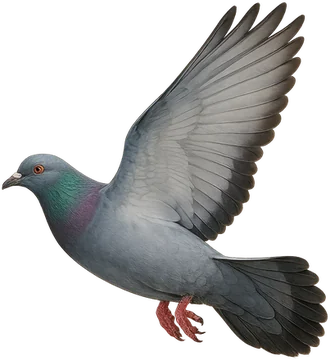
How Roost’s carrier pigeons work
You write a message, choose a bird to carry it, and it flies across a real map to the person you sent it to. Roost shows the trip time before you send, and your friend gets a notification when the bird lands.
- Write your message. Text, a photo, a drawing, a voice note or a GIF.
- Pick your pigeon. Or any other bird you’ve collected.
- Watch it fly. Follow the flight live on the map, or put your phone down until it lands.
Roost’s pigeons are virtual, and unlike real carrier pigeons they can fly anywhere. A real homing pigeon only flies one way: home. To send a message, people had to carry the birds away first and release them with the note. On Roost, your bird flies straight to whoever you choose.
Delivery time depends on distance and on the bird. A pigeon across town lands in minutes; a message to another continent can take days. That’s the idea behind slow messaging.
Not only pigeons
The rock dove, the classic carrier pigeon, is one of more than 1,000 couriers in Roost. There are owls, puffins, parrots, hummingbirds and bats, and slower couriers too, like snails and turtles. Each has its own speed, and some are rare. There’s even Cher Ami, one of the most famous war pigeons, as a Celestial bird.
How real carrier pigeons find their way home
Nobody fully knows how pigeons find home. Scientists agree they use several cues, and still argue about which matter most.
- The sun. Pigeons use the sun as a compass, a finding backed by William Keeton’s classic time-shift experiments.
- Earth’s magnetic field. In a classic 1971 study, magnets on pigeons’ backs confused them on cloudy days but not sunny ones. A popular theory said iron in the beak works like a compass, but a 2012 study found those iron cells are immune cells, not sensors.
- Smell. Pigeons that can’t smell often fail to find home from unfamiliar places. Many researchers think they read a map of smells carried on the wind.
- Roads. GPS tracking shows experienced pigeons often follow highways and turn at junctions on routes they know.
How fast does a carrier pigeon fly?
A homing pigeon can fly at around 60 mph (about 97 km/h). In 1944 a pigeon called William of Orange flew about 250 miles from Arnhem to England in under five hours. Racing pigeons have been recorded flying home from as far as about 1,100 miles away.
A short history of pigeon post
Reuters and the telegraph gap, 1850
In 1850 Paul Julius Reuter, who later founded the Reuters news agency, used homing pigeons to carry news and stock prices between Aachen and Brussels, where the telegraph line had a gap. The pigeons were retired about a year later, once the line was finished.
The Siege of Paris, 1870 to 1871
During the Siege of Paris, pigeons were carried out of the surrounded city by balloon, then flew home carrying messages. The messages were photographed and shrunk onto tiny sheets of film, so one bird could carry thousands of them. In Paris, clerks projected the film onto a screen and copied the messages out by hand. (Pigeon post, Wikipedia)
Cher Ami, 1918
In October 1918, American soldiers later called the Lost Battalion were trapped in France’s Argonne Forest. The story goes that a pigeon named Cher Ami carried the message that stopped friendly shelling, despite being badly wounded. About 194 men walked out when the battalion was relieved days later. Historians now question parts of the story: a Smithsonian curator found nothing conclusive linking Cher Ami to that message. France awarded him the Croix de Guerre, a 2021 DNA test confirmed he was male, and he’s preserved at the Smithsonian’s National Museum of American History.
The pigeons of the Second World War
The Dickin Medal, created in 1943 by the British animal charity PDSA, is often called the animals’ Victoria Cross. 32 pigeons have received it, all for service in the Second World War. One was Winkie. In 1942 a British bomber ditched in the North Sea, and Winkie flew more than 120 miles home, covered in oil, to raise the alarm. The crew was rescued. Another, G.I. Joe, flew 20 miles in about 20 minutes in 1943 to call off an air raid on an Italian village British troops had just taken. PDSA credits him with saving at least 100 soldiers.
Pigeongrams, broadband races and April Fools’
- From 1897, a “pigeongram” service flew messages between Auckland and Great Barrier Island in New Zealand, with its own stamps, until a telegraph cable arrived in 1908.
- In 2009 a South African company raced a pigeon called Winston against its internet connection. Winston flew a memory card about 50 miles and won.
- There’s even a tongue-in-cheek internet standard, published on April Fools’ Day 1990, for sending internet data by pigeon.
Carrier pigeon, homing pigeon or courier pigeon?
A carrier pigeon is a pigeon used to carry messages. The birds that do it are homing pigeons, bred to fly back to their home loft. People also say “courier pigeon”, which means the same thing and has appeared in print since the 1800s, though “carrier pigeon” is the standard term. In Roost, every bird that carries a message is called a courier.